What’s graffiti, what’s postgraffiti. Julio 204 and Daniel Buren in the spring of 1968

Some days ago I got in the mail the book Golden Boy as Anthony Cool, published in New York in 1972. It’s a brief look into the first steps of New York graffiti, in the moment when the phenomenon was starting to take form.

Graffiti in the New York tradition, now spread the world over, started as a systematized version of children graffiti, that ancient custom by which children and teens write their names, likings and aversions on some walls free from parental control.

During the second half of the sixties, this tradition developed with unprecedented intensity among the children and teens of Philadelphia and New York, helped by the recent introduction of spray paint, and parallel with gang graffiti, a close but different phenomenon. In the spring of 1968, Julio 204 carried out the first prominent case of the propagation of a name across a whole neighbourhood. Inspired by his example, others began to reach further. When names started to be written beyond the bounds of the writer’s neighbourhood, graffiti, as we know it today, had appeared.

It is the “all city” concept, to reach all city, the core idea of the movement that would end up covering the landscape of New York with names. The subway soon became the favourite target: on the sides of the cars, along the elevated tracks across the neighbourhoods, the names paraded in front of millions of eyes, from one end of the city to the other. From 1971 on, the phenomenon exploded.

There were soon thousands of writers competing for visibility, to appear more often than their competitors, to “get up” more. The need to make the name stand out in a saturated space resulted, first, in a progressive stylization of the signatures, soon illegible to the layman, and second, in an evolution that transformed them into huge multicolor letterings the size of a subway car.

In a few years a complex culture developed and, by 1973, almost every stylistic and methodological convention that defines graffiti as it is still practiced in New York and the rest of the world –to where it was exported quite literally– was already established. The game of graffiti has perfectly defined rules, that progress pretty slowly. The goal is to gain the respect of the rest of the practitioners, and to get there one has to appear more often, on more hazardous and visible spots, and showing the best style.

The concept of style is specially important. More than to any callygraphic or painting skills, style refers to the freshness and originality with which the narrow graphic vocabulary of graffiti is reinterpreted. Methodology is also determined by rules, from the acquiring of the tools to the choosing of the spots. Although it might appear otherwise, graffiti is a conservative culture, focused on the repetition of its traditions, where creativity is appreciated only up to a certain point.

This results in a game in which the pedestrian is not taken into account at all. Graffiti is a closed code, aimed exclusively at its specialized audience. Only graffiti writers –as the practitioners call themselves– can appreciate the merits and nuances in the work of another writer, from his style to his methodology, starting from the ability to simply read the name.

This is the idea that draws the line between graffiti and postgraffiti.

One of the hundreds of mosaics by Invader in Paris

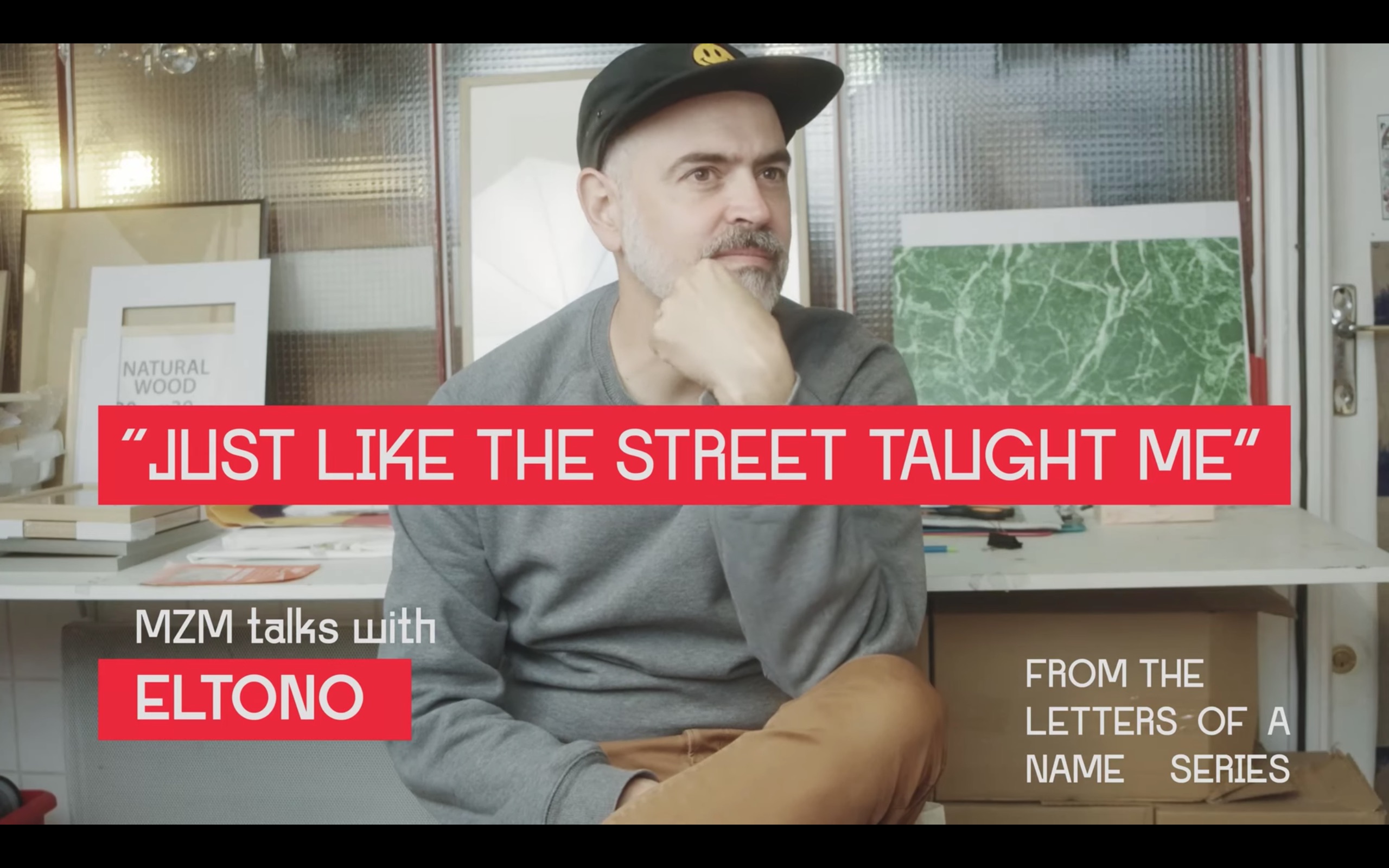
Postgraffiti is a different game, one in which the pedestrian is invited to participate. Some examples of postgraffiti we’ve talked about are Invader and Eltono, two artists that also play the game of “getting up all city”, only in a way we all can understand. What they repeat is not an illegible name but a recognizable image, that any pedestrian can identify with.

The impulse of getting up does not originate in this case from an inside competition between artists. It’s part, instead, of the artist/viewer game that constitutes the aesthetic experience of postgraffiti: the artist reproduces his image, the viewer is surprised in every encounter, and appreciates the way the artist adapts his work to each spot. This game creates a link between both parts, some rare kind of intimate relationship that takes place in public space.

Only in some cases of postgraffiti the repeated theme is limited to a fixed logo. Sometimes it functions, instead, as a mutable icon, as those of Invader or Eltono: an image consistent enough to be easily recognized, but with a range of variation wide enough to retain people’s attention and to confer the artist sufficient space to optimize the process of integration with the context.

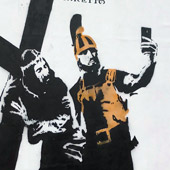
In the cases of Swoon or Banksy, as in most of current postgraffiti, there are no mutable icons, there are just distinctive graphic styles. If the style is distinctive enough and authorship is identifiable, the game is still the same: the relationship between artist and viewer that is the core of postgraffiti.

One of the hand-painted hummingbirds of Birds of Manhattan, the fist series by Dan Witz. New York, 1979

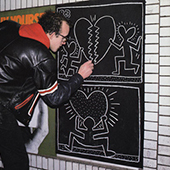
Almost the whole production of urban art in the eighties was postgraffiti, from Dan Witz to Blek le Rat. As is almost all of contemporary urban art, from Shepard Fairey to Roadsworth, including the countless clones of the aesthetic of the cute that for years constituted the bulk of the scene — see these two famous examples.

In the eighties, as well as today, these forms of figurative urban art have emerged from the confluence of western art tradition with different forms of popular culture: punk, skate, subvertising and, most of all, graffiti. They can be considered descendant of the unstoppable cultural current of graffiti, forms of graffiti suitable for the general public. Therefore, the term postgraffiti would be appropriate.

However, the lineage of postgraffiti is as old as that of graffiti. In the summer of 1968, while in New York Julio 204 was starting off modern graffiti, a wholly mature experiment of postgraffiti emerged in Paris.

Daniel Buren, Affichage sauvage. Paris, april, 1968

Daniel Buren (1938) was in 1966 a painter who, after having progressively minimized his vocabulary for some years, had finally limited to use in his canvases only the traditional bicolor fabric of french awnings. Since then, his greatly successful career has consisted in the repetition of the vertical stripe motif.

The start of his popularity came out of his street activities, for which he abandoned the traditional fabric to use printed paper instead, retaining the original width –8′7 cm– and verticality. In march 1968 he started taking his personal icon to public spaces: first on the backs of human billboards, and immediately in the first auffichages sauvages, illegal installations on street-level advertising frames.

In 1969 he called attention to himself when, after having his participation turned down in the collective exhibition When attitudes become form in Bern, Switzerland, he carried out a series of installations around the museum. Since that moment and for several years he used his stripes, that he calls his outil visuel (visual tool) as an icon in a postgraffiti campaign that took him from New York to Tokyo.

Hommes-sandwichs, Paris, march–april, 1968

Exposition personnelle sur les limites de la liberté de l’artiste vis-à-vis de la société, Bern, march, 1969

Cinquante travaux environ New York, New York, october, 1970

Affichage sauvage, part of the project Summershow for Seth Siegelaub gallery, Paris, july–october, 1969

Cent quarante stations du métro parisien, Paris, march–april, 1970

Affichage sauvage in occassion of the Biennal of the X International Exibition, Tokyo, may, 1970

Cinq travaux/peintures, Kyoto, may, 1970

Part 2, with the collaboration of John Weber gallery, New York, april, 1973

Like many artists of the present decade, his illegal work in some cities took place as a consequence, or even as part, of his participation in some artistic event in that place. This way, legal and illegal activities benefit of a mutual feedback: the legal part pays for the trip, while the illegal part serves as promotion. A system that could be called plain and simple guerrilla advertising: the building of the lucrative brand image of an artist at the expense of the taxpayer’s cleaning bill.

All in Buren’s postgraffiti appears incredibly contemporary: his international vocation, his use of printed copies, or his fluent way of matching the legal and illegal sides of his work. It even seems to be winking at graffiti, before graffiti was born: it’s surprising that a piece like Cent quarante stations du métro parisien – which consisted in the installation of his posters on advertising frames in a hundred and forty Paris subway stations, a work that reproduces the essential stage and mechanism of graffiti, was carried out in 1970, even before the moment when, in New York, graffiti jumped from the streets into the subway.

Yet, Buren is not the first historical case of postgraffiti. Another frenchman, Gérard Zlotykamien (1949), began experimenting with his human silhouettes in 1963, and wouldn’t stop using them until forty years later. Neither was Julio 204 the first to write his name all over, there were similar cases as far back as 1959 in Philadelphia. Graffiti and postgraffiti, in fact, are not father and son. They are actually brothers, both born during the turbulent sixties as a response to the corporate monologue of the society of the spectacle.

Comments 18

  1. gallas wrote:

    Como he podido vivir tanto tiempo sin conocer vuestro blog. Mil gracias por semejantes artículos. Espero cada nueva entrega. felicidades!!

    Posted 07 Oct 2008 at %I:%M %p
  2. Remebe.- wrote:

    Siempre digo lo mismo, pero: muy interesante!

    Un saludo.-

    Posted 09 Oct 2008 at %I:%M %p
  3. Escrito en la pared wrote:

    Increíble. Qué bien escrito, qué bien se entiende todo, qué sencillo y que completo a la vez. Enhorabuena.

    Un saludo.

    Posted 09 Oct 2008 at %I:%M %p
  4. glub wrote:

    Esta bien esto!

    pa cuando un “especial” graffiti autoctono de Madrid
    jejeje

    Posted 10 Oct 2008 at %I:%M %p
  5. albertodepedro wrote:

    genial entrada!

    Posted 12 Oct 2008 at %I:%M %p
  6. Perros Callejeros wrote:

    Ostia!

    Dónde has conseguido todas estas fotos de época del trabajo en la calle de Buren?

    Yo estuve rastreando la web como loco y no encontre casi nada!

    Genial blog.

    Posted 09 Dec 2008 at %I:%M %p
  7. carlos wrote:

    buenisimos los articulos! mucha historia y personajes sin conocer

    Posted 24 Dec 2008 at %I:%M %p
  8. david wrote:

    genial el articulo… felicidades

    Posted 28 Dec 2008 at %I:%M %p
  9. issa wrote:

    Me gustó mucho tu artículo. Estoy interesada en el post-graffiti. ¿Qué fuentes me recomiendas? ¿Tienes alguna colección de artículos en línea a la que me puedas referir?

    Posted 08 Jan 2009 at %I:%M %p
  10. Abarca wrote:

    Gracias issa

    No existen apenas publicaciones que ofrezcan análisis de fondo de estos fenómenos, ni en inglés ni en castellano. El blog de Subaquatica, basado también en Madrid, es la única fuente que te puedo recomendar.

    http://subaquatica.com/es/

    Posted 09 Jan 2009 at %I:%M %p
  11. X10 wrote:

    Gracias. Ahora ya sé lo que no sabía

    Posted 30 Mar 2009 at %I:%M %p
  12. espacio_apropiado wrote:

    Hola, yo publiqué un artículo sobre una obra de Daniel Buren en Bruselas q no me dejó buena impresión…

    http://espacioapropiado.blogspot.com/2009/08/mobiliario-urbano-ejem-artistico.html

    Mira que busqué y rebusqué en su página…
    Contigo aprendo que tiene más detrás!
    Aunque creo q se debe de estar haciendo viejo porque la intervención que cito no era muy acertada…les pasa a muchos por desgracia!
    Muy interesante vuestro post. Os sigo siempre!

    Posted 29 Sep 2009 at %I:%M %p
  13. sey wrote:

    Buen articulo , javier!
    saludos

    Posted 10 Dec 2009 at %I:%M %p
  14. ale | fatbombers wrote:

    nice article. it feels good to read some deep articles, from time to time, instead of having images only in graffiti blogs.
    thank you for writing this

    Posted 15 Jan 2010 at %I:%M %p
  15. alexandar wrote:

    es muy bacano tu pajina pero agan mas cosas delo que estedes agan sigan asi y no cambien su forma de ser .
    ok……..

    Posted 09 Apr 2010 at %I:%M %p
  16. alexandar wrote:

    es muy bacano tu pajina pero agan mas cosas delo que ustedes hagan sigan asi y no cambien su forma de ser .
    ok……..

    Posted 09 Apr 2010 at %I:%M %p
  17. A Mac wrote:

    Great article, I just discovered your site. There is a depth of research and fresh perspective here. Bravo.

    Posted 13 May 2010 at %I:%M %p
  18. posted wrote:

    muchas gracias pos esta informacion! i muchas felicidades por esta pagina web, es genial!!!

    Posted 04 Jul 2010 at %I:%M %p

Trackbacks & Pingbacks 4

  1. From Urbanario - Fotógrafos del graffiti infantil on 07 Nov 2008 at %I:%M %p

    [...] poco hablaba de la tradición inmemorial del graffiti infantil, la progenitora directa del graffiti que [...]

  2. From ELTONO - PUBLIC SPACE ARTIST › Graffiti and Postgraffiti on 19 Nov 2008 at %I:%M %p

    [...] Check it here: Que-es-graffiti-que-es-postgraffiti? [...]

  3. From Urbanario - Richard Hambleton on 28 Sep 2009 at %I:%M %p

    [...] Daniel Buren ya había llevado su icono más allá de su París natal a principios de los setenta, Hambleton es [...]

  4. From Urbanario_actuaciones artísticas no reguladas y espacio público - Zoohaus on 18 Oct 2009 at %I:%M %p

    [...] mina, vamos, y preciosa. Desde el vagabundo que grababa superficies en parís a las diferencias entre graffiti y postgraffiti, modificación y réplica de elementos urbanos o el arte de borrar graffiti. Bueno, y muchas otras [...]

Post a Comment

Your email is never published nor shared. Required fields are marked *